Briefly Explain the Different Types of Electromagnetic Energy
The moons mass is much lower than the earths. Sound waves travel through the air or another medium.

Electromagnetic Spectrum Quiz Middle School Science Resources Electromagnetic Spectrum Science Lessons
The total amount of energy of the field and the materials it affects is called electromagnetic field energy.

. Radio waves have the longest wavelength and gamma rays have the shortest wavelength. Some types of electromagnetic waves like radio waves microwaves infrared waves visible light and ultraviolet waves can be reflected and refracted. The seven types of electromagnetic waves are.
Amplitude is one-half the height of the wave from peak to trough. The electromagnetic force is one of the four fundamental forces and exhibits electromagnetic fields such as magnetic fields electric fields and light. 3 EM waves also exert pressure which is shown by a radiometer.
Electromagnetism is a branch of Physics that deals with the electromagnetic force that occurs between electrically charged particles. Examples of Electromagnetic Energy. Refraction is caused by differences in the.
This lack of an atmosphere and the moons small size allowed it to become cool enough to the point at which it completely solidified. Thus for electromagnetic radiation in a vacuum speed is equal to the fundamental constant c c. Alpha beta neutrons and electromagnetic waves such as gamma rays.
This form of energy can travel through empty space as a transverse wave. There are several waves of various wavelength and frequency present in the Electromagnetic spectrum. The electromagnetic EM spectrum encompasses all wave frequencies including radio visible light and X-rays.
These differences permit us to distinguish different. Electromagnetic Energy Facts The different types of electromagnetic waves are light microwaves x-rays and TV and radio transmissions. The first is an alpha particle.
Radiation is energy that travels and spreads out as it goes the visible light that comes from a lamp in your house and the radio waves that come from a radio station are two types of electromagnetic radiation. Radio gamma rays x-rays microwaves and ultraviolet light are some examples of electromagnetic energy. EM waves are the only waves able to carry energy across a vacuum.
The product of a waves wavelength λ and its frequency v v λν is the speed of the wave. We receive EM radiation as information over various wavelengths and frequencies through waves or particles which ultimately form the electromagnetic spectrum. What kinds of energy make up the electromagnetic spectrum.
Types of Electromagnetic Radiation Electromagnetic radiation with the shortest wavelengths no longer than 001 nanometer is categorized as gamma rays 1 nanometer 10 9 meters. You can treat light as EM wave or stream of energy. These particles consist of two protons and two neutrons and are the heaviest type of radiation particle.
All waves including forms of electromagnetic radiation are characterized by a wavelength denoted by λ the lowercase Greek letter lambda a frequency denoted by ν the lowercase Greek letter nu and an amplitude. When electromagnetic energy from the sun hits the earths surface three fundamental energy interactions are possible. The different waves present in the electromagnetic spectrum are.
The difference between different types of EM waves is wavelength. They differ in mass energy and how deeply they penetrate people and objects. Though the sciences generally classify EM waves into seven basic types all are.
There are many different types of electromagnetic energy. Lets start with the most visible type of electromagnetic radiation. If our eyes could see radio waves we could in theory watch TV programs just by staring at the sky.
The Electromagnetic waves are the waves which are transverse in nature. It is the basic reason electrons are bound to the nucleus and are responsible. All EM waves are made up of photons that travel through space until they interact with matter.
Some waves are absorbed and others are reflected. Exposure to these high-energy waves can alter atoms and molecules and cause damage to cells in organic matter. A sonic boom a song played on a stereo your voice.
This type of radiation derives from what our eyes perceive as a clear observable field of view. Sonic Energy Sonic energy is the energy of sound waves. 1 EM waves can impart momentum and angular momentum to the material with which it interacts.
Obviously used for cooking in microwave ovens but also for transmitting information in radar equipment. By Luc Braybury. Types of electromagnetic radiation Radio waves infrared rays visible light ultraviolet rays X-rays and gamma rays are all types of electromagnetic radiation.
The proportions of energy reflected absorbed and transmitted will vary for different earth features. Gamma rays x-rays and some ultraviolet waves are ionizing meaning these waves have such a high energy that they can knock electrons out of atoms. Therefore its gravity isnt strong enough to hold an atmosphere.
2 Electromagnetic waves carry energy. Nearly all frequencies and wavelengths of electromagnetic radiation can be used for spectroscopy. The other types of EM radiation that make up the electromagnetic spectrum are microwaves infrared light ultraviolet light X-rays and gamma.
Astronomers use a number of telescopes sensitive to different parts of the electromagnetic spectrum to study objects in space. Various fractions of the energy are. Electromagnetic waves are waves that can travel through the emptiness of space at the speed of light.
Of the many types of energy in our universe this form of energy is the only one that does not require a medium or matter to travel on or in. C 2998108ms1 λν c 2998 10 8 ms 1 λ ν. See Units Used in Science.
There are four major types of radiation. Briefly explain why the moon doesnt have an atmosphere or plate tectonic activity. Observatories Across the Electromagnetic Spectrum.
UV VL and IR are producing by excited atoms. Even though all light is fundamentally the same thing the way that astronomers observe light depends on the portion of the spectrum they wish to study.
Electromagnetic Energy Understanding The Power Of Waves

The Electromagnetic Spectrum 8th Grade Science
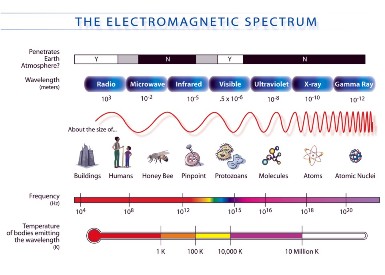
Physics For Kids Types Of Electromagnetic Waves

Electromagnetic Energy Facts And A Qualitative View
No comments for "Briefly Explain the Different Types of Electromagnetic Energy"
Post a Comment